For twelve days, Harold Jenkins had tried everything else.
That was the part nobody inside the university administration building knew.
And the reason everything that happened afterward mattered.
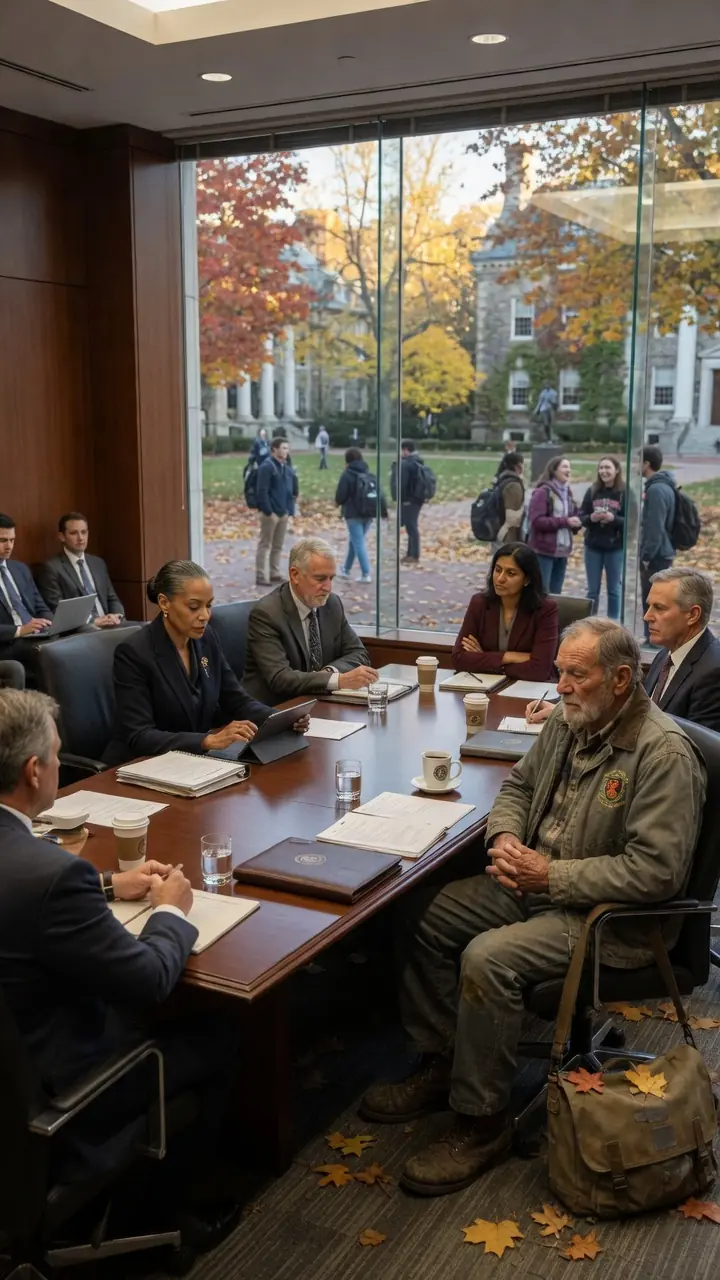
When Dr. Victoria Reynolds looked through the glass walls of the executive conference room and saw the elderly white man waiting outside, she immediately assumed she knew exactly why he was there.
Seventy-four years old.
Thin gray hair.
A neatly trimmed gray beard.
Weathered hands.
A faded maintenance jacket with the university logo stitched above the pocket.
Work boots stained by decades of soil, rain, and grass.
Harold had spent forty-two years working on campus.
Most students barely noticed him.
Most professors didn't know his name.
To Victoria Reynolds, he was simply another employee unhappy about change.
Another person unwilling to accept progress.
Another meeting that would waste thirty minutes of her afternoon.
She couldn't have been more wrong.
Three weeks earlier, the university board approved a redevelopment project worth nearly three hundred million dollars.
The plan would demolish the Jefferson Community Learning Center.
In its place would rise a state-of-the-art technology complex funded by corporate partners.
The board celebrated.
Investors celebrated.
Local politicians celebrated.
The newspapers called it visionary.
Only one group wasn't celebrating.
The children.
Every afternoon more than two hundred low-income students used the center.
Some came for tutoring.
Some came for free meals.
Some came because it was the safest place they knew.
Many of them would have nowhere else to go once the doors closed.
Harold knew every one of those children.
He knew which ones were struggling with math.
Which ones lived with grandparents.
Which ones quietly took extra food home because there wasn't enough in the refrigerator.
For forty years, after finishing his maintenance shifts, Harold stayed and volunteered.
Nobody paid him.
Nobody asked him to do it.
He simply showed up.
Again and again.
Year after year.
When the closure was announced, Harold started fighting.
First came the letters.
Seven of them.
None received a response.
Then came the emails.
Ignored.
Then meetings with department heads.
Denied.
Then the board.
Rejected.
Then local officials.
Dismissed.
Finally he stood before the university trustees.
One trustee glanced at Harold's maintenance badge and whispered to another:
"Why are we listening to the gardener?"
Several members laughed.
Harold heard them.
He pretended not to.
But that night, sitting alone in his apartment, the words stayed with him.
Not because they hurt.
Because they reminded him of something he thought he had left behind decades ago.
Being invisible.
Forty-eight years earlier Harold had been invisible too.
At twenty-six he was a young father raising twin boys.
Then a drunk driver crossed the center line.
One son died instantly.
The other survived but required years of treatment.
Medical bills consumed everything.
The savings.