I'm not moving until somebody tells me why 50 grown men in this town let a boy spit on an old man's boots. Arthur Pendleton said it low, almost bored, while smoke curled from the cigarette between his fingers. Behind him, oil pulled black beneath a dying 1948 Harley-Davidson, its engine ticking like a heart giving out. Nobody in Oak Haven knew yet that the quiet man they were mocking carried a name that could shake the whole state. Before we go further, subscribe, hit follow, and drop the name of your city in the comments below so I can see how far this story has traveled.
Now, here's what really happened that day. The engine had been screaming for almost half a mile before it finally gave out in the exact center of Main Street, right where Oak Haven's Little World crossed itself. The bakery on one corner, the hardware store on the other, the diner windows fogged with the smell of frying bacon. The sound it made when it died wasn't gentle. It wasn't the polite little sputter people expected from an old machine finally resting.
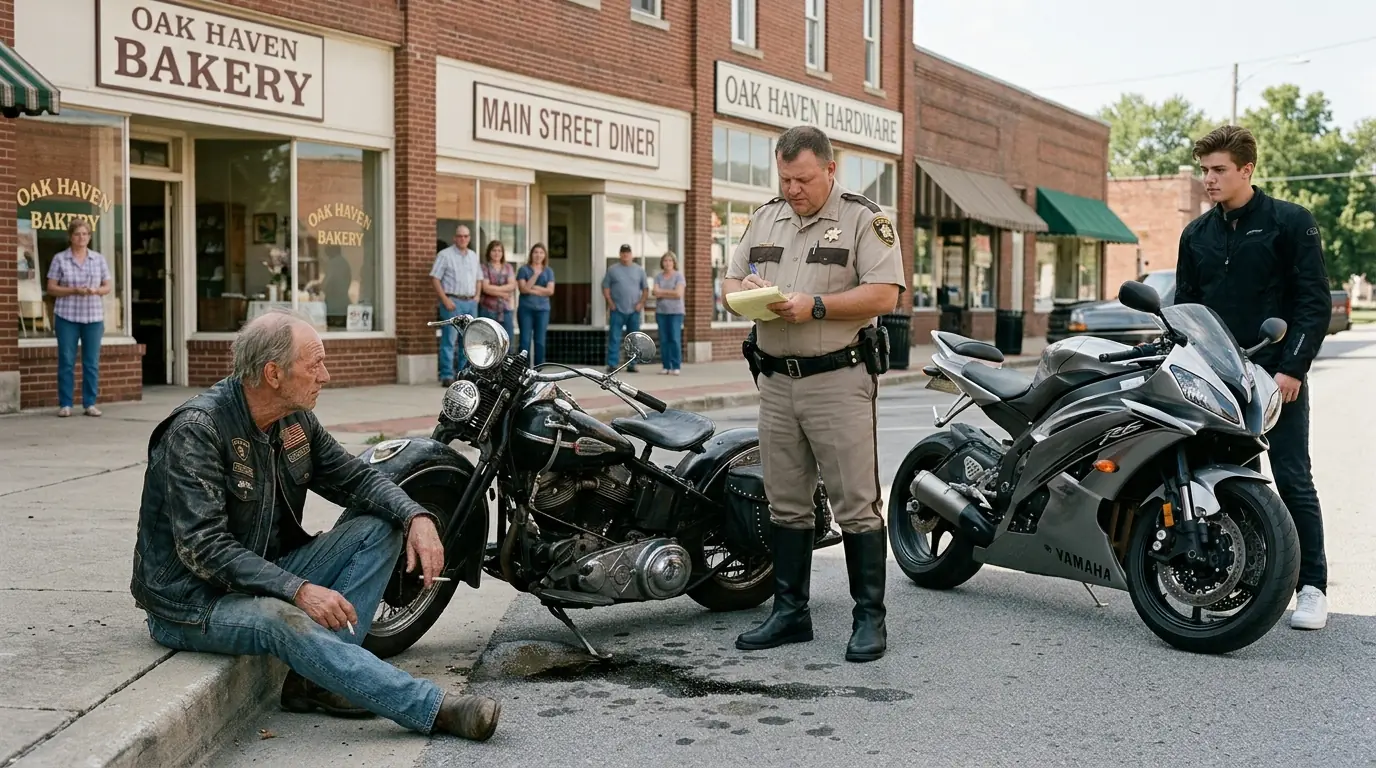
It was violent metallic, a shriek that made two women jump and a delivery boy nearly dropped a case of soda bottles. Then silence, then the slow, ugly hiss of oil finding the pavement, spreading out from beneath the bike in a black spidering stain. Arthur sat there for a long moment without moving both boots, still planted on either side of the machine hands, still on the grips, like maybe if he just waited, it would forgive him, and roar back to life. It didn't. He exhaled slowly through his nose, swung one leg over with the stiffness of a man whose knees had earned every one of his 73 years, and stood looking down at the mess like a man staring at an old friend who had just collapsed in front of him.
"Great," he muttered. Perfect place for it, too. It didn't take long for Oak Haven to notice. It never did. Small towns had a way of finding an audience for anything unusual within minutes.
And an old biker's dead motorcycle bleeding oil across Main Street on a Tuesday afternoon was about as unusual as it got. Windows filled with faces. The bakery door opened. A woman stepped halfway out with flowers still on her apron craning her neck. The first real voice belonged to Tommy Miller.
He came around the corner with two of his friends, all three of them, 17, all three of them wearing the kind of grin that came from never once being humbled by life. Tommy slowed his bike a chrome and plastic thing that cost more than Arthur's monthly pension and let his sneakers scrape the pavement as he stopped a few feet away. Well, would you look at that? Tommy said loud enough for the gathering crowd to hear. Grandpa's toy broke down.
His friends laughed. One of them, a lanky kid named Derek, pulled out his phone and started filming before Arthur had even looked up. "Careful," Arthur said without turning his head. "Camera adds 10 pounds. Might not want to be in this footage.
" "Oh," Derek said, delighted. "He's got jokes. " Tommy circled his bike slowly around the leaking oil, careful not to get any on his shoes, eyeing Arthur's Harley like it was a dead animal on the road. "This thing even run, or is it just for decoration like you? " It ran fine for 40 years before you were a thought in anybody's head," Arthur said.
"40 years? " Tommy repeated, laughing. "Yeah, that tracks looks like it's been dead about that long, too. " More laughter. The crowd was growing now.
A man in a flannel shirt leaning against the hardware store's brick wall. Arms crossed, smirking. Two teenage girls giggling behind their hands. An older woman shaking her head with a particular disgust reserved for things she decided were beneath her notice. Arthur crouched down beside the bike, running two fingers through the oil, checking the color, checking for metal shavings, doing the quiet ritual of a man who had fixed this same machine a 100 times before.
His face didn't change. Not when Tommy called out again. Not when someone in the crowd muttered the word vagrant. Not when a woman near the bakery said just loud enough to be heard that somebody should call about getting that thing removed before it became an eyesore. That thing, Arthur said quietly, almost to himself, has more history than this whole street.
"What was that, old man? " Tommy stepped closer, emboldened by his audience. Speak up, or is that hearing aid busted, too? Arthur looked up at him, then really looked, and for just a moment, a moment none of them would remember correctly later because none of them were paying close enough attention. Something passed behind his eyes.
Not anger, something colder and steadier than anger. the look of a man who had been underestimated before many times by people far more dangerous than a 17-year-old with a chrome motorcycle in an audience to perform for. Nothing, Arthur said, standing back up, brushing his hands on his jeans. Nothing worth explaining to you. That should have ended it. It didn't.
The sheriff's cruiser rolled up 8 minutes later, lights on, but no siren easing to a stop at an angle that blocked half the street, even more than the dead motorcycle already had. Sheriff Dale Whitfield stepped out slow, adjusting his belt, surveying the scene with a weary expression of a man who'd rather be anywhere else. All right, all right. What do we got? He said, not really a question.
Bike died right in the middle of the street, someone called out. Guy won't move it. I'm not refusing to move it, Arthur said evenly. It's dead. Dead things don't move themselves.
I need it towed. Whitfield walked a slow circle around the Harley, taking in the oil stain, the cracked leather seat, the faded paint, the man standing beside it with his arms folded and his face unreadable. He didn't ask Arthur if he was hurt. He didn't ask if he needed help. He pulled out a little notepad instead, the kind used for parking violations, and started writing.
"You can't just leave a broken down motorcycle blocking traffic," Whitfield said, not looking up. "I'm aware," Arthur said. "I called for a tow. It's coming. How long's that going to take?
However long it takes. Whitfield sighed like the answer personally offended him. This is Main Street. People got places to be. People had places to be a hundred years before this street existed, too.
Arthur said somehow they managed. A ripple of laughter went through part of the crowd, not with Arthur, but at the absurdity of an old man mouthing off to the sheriff. Tommy sensing an opening chimed back in. "Sheriff, can't you just like tow it now? Dude's a menace.
Probably doesn't even have insurance. " "Watch your mouth, son," Arthur said. And for the first time, there was an edge in his voice, thin but unmistakable, like a blade catching light. "Or what? " Tommy said, grinning wider now, playing to the phone, still recording in Derek's hand.
"You going to do something, old man? What are you going to do? " Arthur didn't answer. He turned instead and lowered himself onto the curb, slow and deliberate, the way a man sits when his body has fought him on every movement for the last decade. He pulled a cigarette from his vest pocket, the vest worn, leather cracked at the shoulders, patches faded almost to nothing by sun and rain, and years nobody in this crowd could have imagined, and lit it with a lighter that looked older than most of the people watching him.
He said nothing else. He just sat there and smoked, watching the street, watching the crowd, watching a town that had already decided exactly what he was and wasn't worth. "Somebody should call the county," the woman from the bakery said to Whitfield. "This is a public safety issue. " "I called the tow already," Arthur said without looking at her.
""Would you plan on paying for it? "" "Excuse me? " "Didn't think so. " Whitfield closed his notepad with a snap. "Look, old-timer.
I'm going to need you to move along once that bike's out of here. We don't need this kind of thing happening in town. This kind of thing? Arthur repeated slowly, tasting the words. You mean a man's motorcycle breaking down?
I mean trouble, Whitfield said. I know your type. Arthur almost laughed at that. Almost. No, he said quietly.
You really don't. Nobody heard him say it except the man standing closest, an older mechanic named Frank Doyle, who'd wandered over from his shop two doors down, wiping grease off his hands with a rag drawn by the commotion like everyone else. But unlike everyone else, Frank wasn't looking at Arthur's face or his cracked leather boots or his stubborn silence. Frank was looking at the bike. He crouched slowly, studying the engine, the frame, the hand-stamped serial number barely visible beneath decades of grime.
His eyebrows drew together. "This a Panhead? " Frank asked more to himself than anyone. "1948? " Arthur said, not turning his head.
Frank's hand hovered over the tank, tracing the shape of a symbol worn nearly invisible beneath layers of old paint and older dust. This ain't a stock frame. Somebody modified the Frank quit wasting time with that junk pile and helped me figure out how we're clearing this street. Whitfield snapped. Frank straightened up slowly glancing between the sheriff, the crowd, and the old man still sitting silent on the curb.
Something in his face had shifted a flicker of recognition he couldn't quite place, like hearing the first few notes of a song from childhood and not remembering the name. He opened his mouth to say something else, then closed it again, deciding against it. Nobody else noticed. Nobody else cared. The crowd's attention had already drifted back to Tommy, who was circling his bike again.
Phone boy Derek still filming building towards something. You old man, what's that patch on your back supposed to mean anyway? Tommy called out. Looks like something you found in a dumpster. For the first time, Arthur turned fully around, giving the crowd a clear look at the back of his vest.
Leather cracked with age, sun-bleached at the edges and across the shoulders, faded almost to a ghost of itself. the outline of the two-wing letters in a shape most of Oak Haven had only ever seen in movies or news footage about outlaw motorcycle gangs from decades past. Nobody in the crowd recognized it. Not really. It had faded too much, and none of them were looking closely enough. And small towns like Oak Haven didn't spend much time thinking about the kind of organizations that existed three states over and a lifetime away from their quiet little main street.
Except Frank. Frank's eyes went wide for just a second before he caught himself. That patch, Tommy said, laughing. Belongs on a Halloween costume. Or in a museum, one of his friends added like him.
The crowd laughed again louder this time. And something in the sound of it, the collective cruelty of a dozen people who felt safe mocking someone because they had already decided he was powerless, made even Whitfield crack a small, tired smile, the kind that said he wasn't going to stop it. Arthur turned back around slowly facing the street again and took another pull from his cigarette. His jaw was tight, his shoulders were tight, but his voice when he finally spoke was as calm as still water. "Laugh all you want," he said.
"Won't be laughing later. " "Is that a threat, old man? " Whitfield asked, stepping closer, hand resting near his belt in a way that was probably meant to look casual and didn't. It's a fact, Arthur said. "There's a difference.
You'll learn it eventually. " You threatening an officer now? " Whitfield's voice sharpened. "I said it's a fact," Arthur repeated. "Facts don't need threats to be true.
" The tension in the air thickened the kind of silence that made the crowd lean in without realizing they were doing it, sensing that something had shifted, even if they couldn't name what. Whitfield's hand stayed near his belt a beat too long before he seemed to think better of it, straightening up instead, adjusting his hat. Just move your junk off my street, he said before I have it impounded. Can't move a dead engine, Sheriff. Arthur said physics doesn't care about your schedule.
A few people snickered at that, not with Arthur exactly, but at Whitfield's obvious frustration, which only made the sheriff angrier. He turned and stalked back toward his cruiser, muttering something about calling for a flatbed himself, um, if the old man's tow didn't show. soon leaving Arthur alone on the curb with his cigarette and his dead motorcycle and an entire town's worth of eyes on him. It was Tommy who wouldn't let it rest. He walked his bike closer, close enough that Arthur could have reached out and touched the front wheel if he wanted to and leaned down, getting right into the old man's space in a way that made even some of his friends shift uncomfortably. "Hey," Tommy said, quieter now just for Arthur.
"You going to cry about this? Bet you will. Old men cry about everything once they get soft. Arthur didn't move, didn't flinch. He simply looked up at the boy with an expression that made Tommy's grin falter just slightly just for a second before he covered it by laughing and standing back up.
"Whatever, man. " Tommy said louder now, playing to the crowd again. "Not worth my time. " "No," Arthur agreed quietly. "It's really not.
" The crowd began to thin after that, the way crowds do once the initial spectacle loses its edge. People drifting back into the bakery, back into the hardware store, back to their errands already composing the story they'd tell at dinner about the crazy old biker who broke down on Main Street and mouthed off to the sheriff. Derek stopped filming, satisfied he'd gotten enough for whatever he planned to post later. Tommy and his friends rode off toward the edge of town, already laughing about something else the old man already forgotten in the way teenagers forget most things that don't directly concern them. But Frank Doyle didn't leave.