Then she heard the first cry.
A thin, furious sound.
Another followed.
Then silence.
“Baby C?” Emily gasped.
“Working on her,” someone said.
Emily’s vision blurred. She imagined Mark walking in, finally sorry, finally terrified, finally choosing her. Instead, a nurse squeezed her hand.
Hours later, Mark returned to the hospital smelling faintly of frosting and Madison’s perfume. He rehearsed irritation on the elevator ride: Emily was dramatic. Hospitals exaggerated. He would say his phone died.
But the maternity room was empty.
The bed was stripped. The flowers from his office sat untouched on the windowsill. No wife. No babies.
A nurse passed by with charts. Mark grabbed her sleeve.
“Where is Emily Carter? My wife. Triplets. C-section.”
The nurse blinked. “Emily Carter?”
“Yes.”
Her expression shifted from confusion to concern.
“She left four days ago,” the nurse said slowly. “Isn’t she home?”
Mark froze.
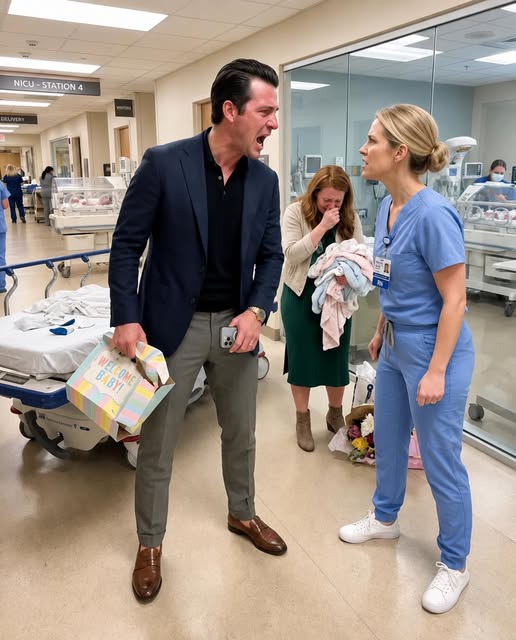
The silence in room 412 was not the quiet of peace; it was the absolute, suffocating vacuum left behind when life had been aggressively ripped away and nothing remained but phantom echoes. Mark stood frozen in the center of the sterile, pale-green maternity suite, the lingering scent of Madison’s expensive white chocolate perfume and French vanilla frosting still clinging to the collar of his designer shirt like an accusing fingerprint. It clashed violently with the harsh, clinical tang of antiseptic and bleached linens.
He looked down at his Rolex. The date was stark and unyielding. Four days. The nurse’s words played on a loop inside his skull, echoing louder than the emergency monitors that had screamed there less than a week ago. “She left four days ago. Isn’t she home?”
“That’s impossible,” Mark muttered, his voice cracking against the drywall. He spun around, his eyes darting to the unmade bedside table. The floral arrangement he had hastily ordered from a kiosk four days ago—red roses that were meant to symbolize passion, though he had bought them out of mere obligation—were now withered, drooping over the ceramic vase like mourners bowing their heads. The water inside had turned a murky, stagnant brown. Not a single petal had been cleared away. No one had checked in. No chart hung from the foot of the bed. The mattress was stripped down to its bare, gray-stained plastic ticking, looking less like a place where human life had been saved and more like a slab in a morgue.