Ma'am, stop right there. I'm ordering you to identify yourself now. This is a public sidewalk. I'm walking my dog. What crime do you suspect me of?
You match a suspect description. Don't argue the law with me. You don't have reasonable suspicion. This is not Turn around. Hands behind your back.
Now, for the record, I do not consent. You are violating my rights. Judge Evelyn Moore did not look like a threat. At 58 years old, she carried herself with the kind of effortless posture that comes from decades of demanding order in a courtroom. She was dressed in a sensible, high-quality navy blue tracksuit, the kind worn by women who value comfort, but refused to look sloppy.
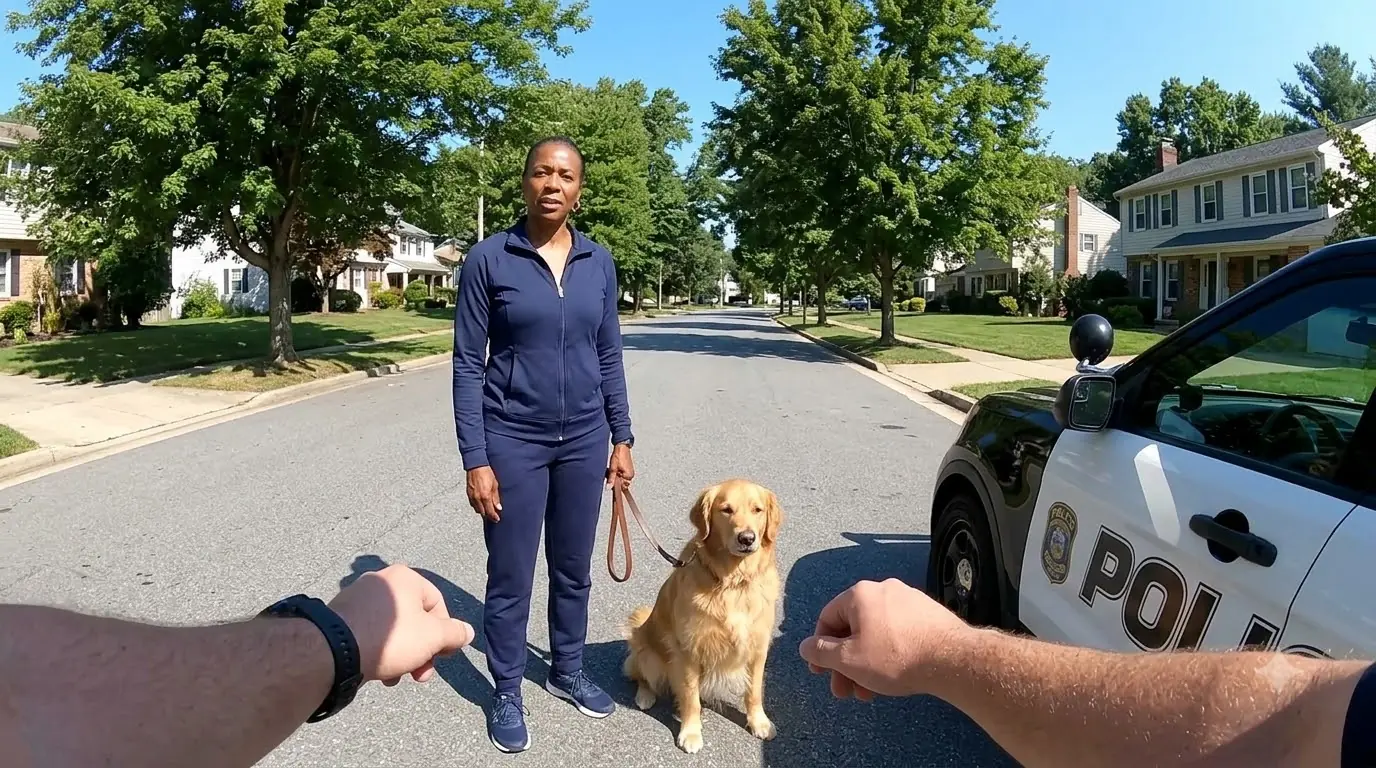
On her feet were expensive walking shoes, and in her left hand she held a leather leash attached to Barnaby, her 7-year-old golden retriever. Barnaby was wagging his tail, sniffing at a fire hydrant, utterly unconcerned with the mechanics of criminal justice. Evelyn was enjoying her Saturday morning. The week had been particularly grueling, a custody battle involving three states and allegations of fraud that had required her to pour over documents until midnight for 4 days straight. This walk was her sanctuary.
It was her time to clear her head, to breathe in the fresh air, and to simply be a neighbor in the community where she had lived for 15 years. She had just turned the corner onto Maple Drive, heading back toward her colonial-style home, when the black and white cruiser rolled slowly alongside her. She noticed the car, of course. Being a black woman in America, regardless of one's station in life or bank account balance, meant possessing a peripheral awareness that never truly slept. She saw the vehicle slow to a crawl.
She felt the weight of the gaze coming from behind the tinted glass, but she didn't stop. She had no reason to. She gave the leash a gentle tug. "Come along, Barnaby," she murmured her voice calm, possessing the rich to tumber that had silenced arguing attorneys more times than she could count. The cruiser accelerated slightly, then pulled sharply to the curb, blocking her path on the sidewalk.
The passenger window didn't roll down. Instead, the driver's door opened. Officer Kyle Braden emerged. He was 29 years old with the high and tight haircut of someone who desperately wanted to be perceived as a soldier rather than a peace officer. He had been on the force for 4 years, long enough to shed his rookie jitters, but not long enough to acquire actual wisdom.
He adjusted his duty belt, a nervous tick that Evelyn recognized immediately from the hundreds of bailiffs and deputies she had worked with over the years. He placed his hand on the radio at his shoulder, his stance widening aggressively. "Ma'am, hold it right there," Braden called out, his voice was loud, shattering the suburban peace. Evelyn stopped. She didn't flinch.
She turned slowly, her face a mask of polite but cool inquiry. She shortened the leash, bringing Barnaby to sit by her left leg. The dog looked at the officer and let out a friendly pant. "Is there a problem, officer? " Evelyn asked.
Her diction was precise, her tone level. It was the voice she used when a witness was beginning to stray from the facts. "I need you to stay right where you are," Braden said, walking around the front of his cruiser. He didn't offer a greeting. He didn't smile.
His eyes were scanning her, not looking for a weapon, but looking for a reason. We've had reports of suspicious activity in the neighborhood. Breakins, people casing houses. Evelyn raised an eyebrow. I see.
And what does that have to do with me? You fit the description of a suspicious individual reported earlier. Braden lied. Or perhaps he wasn't lying to her. Perhaps he was lying to himself, convincing his own mind that his bias was actually intuition.
I'm going to need to see some identification. Evelyn Moore had written opinions on the Fourth Amendment. She had presided over cases where the validity of a stop determined whether a child would be removed from a home where drugs were found. She knew the law not as a theory, but as the very architecture of her life. Officer," she said, shifting her weight slightly.
"I am walking my dog on a Saturday morning. I am a resident of this neighborhood. Unless you can articulate a reasonable suspicion that I have committed a crime, or am about to commit one, I am under no obligation to provide you with identification. This is a consensual encounter, is it not? " Braden blinked.
He hadn't expected the vocabulary. He hadn't expected the steady gaze. Most people, when confronted by the uniform, crumbled or argued emotionally. This woman was doing neither. She was lecturing him.