The HOA president called the police on me for moving out, as though leaving the neighborhood were somehow a crime.
I was loading the final box into my moving truck when Vivian Blackwood came storming down the sidewalk in a two-hundred-dollar yoga set, waving her phone like a weapon.
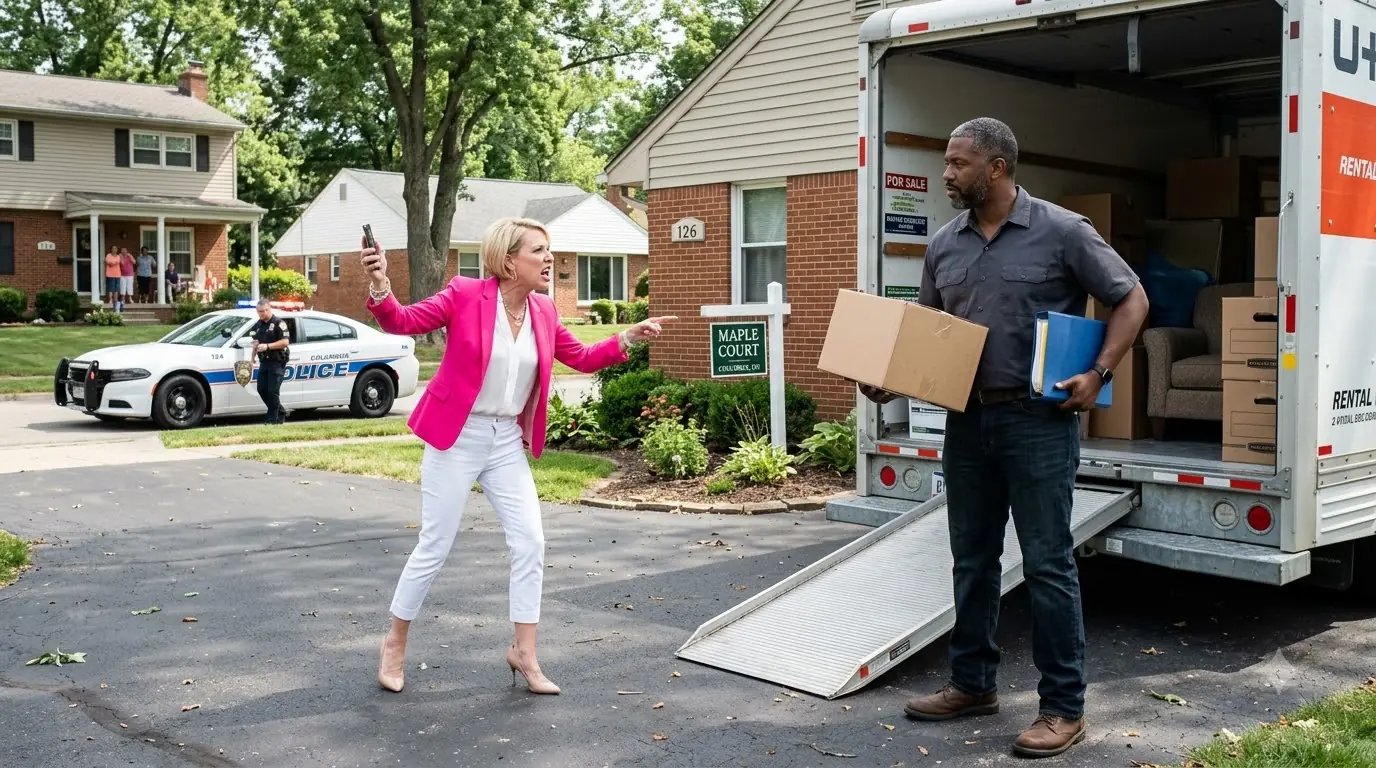
“Officer, he is abandoning community assets,” she shouted. “He is destroying our property values.”
Gravel cracked beneath her designer sneakers as she marched toward me. Diesel exhaust from the moving truck drifted across the cul-de-sac and mixed with her expensive perfume.
I had to bite the inside of my cheek to keep from laughing.
While Vivian screamed about community standards, I had something in my back pocket that was about to turn her entire world upside down. It was something she never imagined a person like me could accomplish.
I did not argue. I did not defend myself.
I simply looked her in the eye.
“Vivian, you might want to sit down for this.”
To understand how we reached that moment, I need to explain how the war began.
My name is Marcus Fletcher. Six months earlier, I had been a man trying to rebuild his life after the kind of divorce that allowed lawyers to purchase vacation homes.
I worked as a construction project manager and owned Fletcher Contracting. Before entering private business, I had spent twenty years working in large-scale engineering and infrastructure projects.
I believed in rules, but I also believed those rules should apply equally to everyone.
Willowbrook Estates appeared perfect when I first visited. It was a quiet American suburb with decent neighbors and cookie-cutter ranch houses built during the 1990s.
Children still played outside. Lawns were tidy, traffic was light, and every house looked like a place where someone could begin again.
The real estate agent mentioned an HOA but described it as a simple organization responsible for lawn care and snow removal.
She forgot to mention the dictator.
Vivian Blackwood ruled Willowbrook like a personal kingdom.
She had served as HOA president for eight years. During the day, she worked as a real estate agent, and during every other waking hour, she acted like the neighborhood belonged to her.
Vivian always wore perfectly coordinated workout sets and drove a spotless white BMW X5 that looked as though it were detailed twice every week.
Three weeks after I moved in, I walked outside and found a crisp envelope tucked beneath my windshield wiper.
The paper crackled as I unfolded it.
Violation Notice: Unapproved Commercial Vehicle in Driveway.
The vehicle in question was my work truck, a clean and professionally maintained Ford F-250 with small company lettering on the doors. It was parked inside my own driveway.
The morning coffee turned bitter in my mouth when I read the penalty.
Seventy-five dollars, payable within ten days.
Failure to comply could result in a property lien.
Three houses away, Bob Martinez had a boat trailer that had been sitting in his driveway since Memorial Day. It was coated in pollen, one tire was flat, and the trailer occupied twice as much space as my work truck.
Bob had received no violation notice.
I soon learned that Bob’s wife worked at Vivian’s real estate office.
Convenient.
That evening, I opened the HOA handbook.
It contained eighty-two pages of bureaucratic torture, but inside Section 4.3, I discovered something beautiful.
Board members were subject to enhanced penalties for violations because they were expected to model community standards. Any board member who broke the rules could receive double fines.
The game had changed.
For the next two weeks, I used my professional camera to document Vivian’s violations. Every photograph included timestamps, location data, and complete metadata.
Old habits from years of project management were difficult to lose.
Her violations were everywhere.
Vivian’s BMW blocked the public sidewalk for twelve minutes almost every morning. That created a one-hundred-fifty-dollar municipal violation.
She had six ceramic garden gnomes despite the HOA’s prohibition on lawn ornaments. Each one carried a seventy-five-dollar penalty.
Four security cameras pointed toward public areas without board approval. Each camera created another two-hundred-dollar violation.
While Vivian harassed me about a professionally maintained work truck, she had accumulated roughly eight hundred dollars in penalties.
What truly angered me came later.
I began knocking on doors and speaking with neighbors.
Vivian had been terrorizing Willowbrook for years.
Mrs. Stella, the kind elderly woman living beside me, had been fined two hundred dollars because her rose bushes were two inches taller than Vivian’s preferred limit.
A young family across the street nearly moved after Vivian repeatedly cited them for their children’s sidewalk chalk.
Everyone paid.
Everyone lowered their heads.
The neighborhood constantly smelled of fresh paint because residents were scrambling to satisfy arbitrary exterior-color requirements. Measuring tapes had practically become the soundtrack of Willowbrook as homeowners checked grass height, mailbox placement, and decorative trim.
The rules seemed to change whenever Vivian needed another excuse to control someone.
Then I discovered the real problem.
Property ownership records are public, and something about Vivian’s address did not make sense.
According to the county assessor, the house at 47 Maple Court, Vivian’s premium corner-lot palace, belonged to Clearwater Investment Holdings LLC.
Vivian did not own it.
She was a tenant.
The HOA bylaws were clear. The board president had to be a property owner inside the community.
A renter could not legally hold the position.
Vivian’s entire eight-year reign was invalid.
I sat in my kitchen that night staring at the property records.
While she had spent years acting like the queen of Willowbrook, Vivian had violated the organization’s most fundamental rule.
It was time for a reality check.
The following morning, I walked to her front door.
The scents of expensive coffee and vanilla candles drifted outside when she opened it. Her expression shifted immediately from a professional smile to concealed irritation.
“Mr. Fletcher,” she said. “What can I do for you?”
I held up my phone.
“I wanted to discuss the violation notices I will be submitting.”
Her perfectly shaped eyebrows rose.
“Excuse me?”
“Section 12.7 prohibits lawn ornaments. You have six garden gnomes at seventy-five dollars each.”
I moved to the next photograph.
“Section 15.4 prohibits unauthorized surveillance equipment. That is two hundred dollars per camera.”
I showed her another image.
“Then there is the daily sidewalk obstruction caused by your BMW.”
The scent from the candle could not cover the sudden nervousness in the doorway.
“That is different,” Vivian said. “Those are decorative elements that enhance property values.”
“According to whom?”
I scrolled through the handbook on my phone.
“The rules contain no exception for decorations you personally approve.”
I held up the penalty calculation.
“Section 4.3 doubles fines for board members, so your current total is approximately sixteen hundred dollars.”
Vivian’s face lost color beneath her professional spray tan.