Fourteen men in tactical gear arrived before sunrise carrying a steel battering ram and an eviction order with Grant Mercer's name forged across the bottom.
Behind them stood the HOA president, smiling as if the house already belonged to her.
She ordered them to break down the door, drag him outside, and seize everything inside.
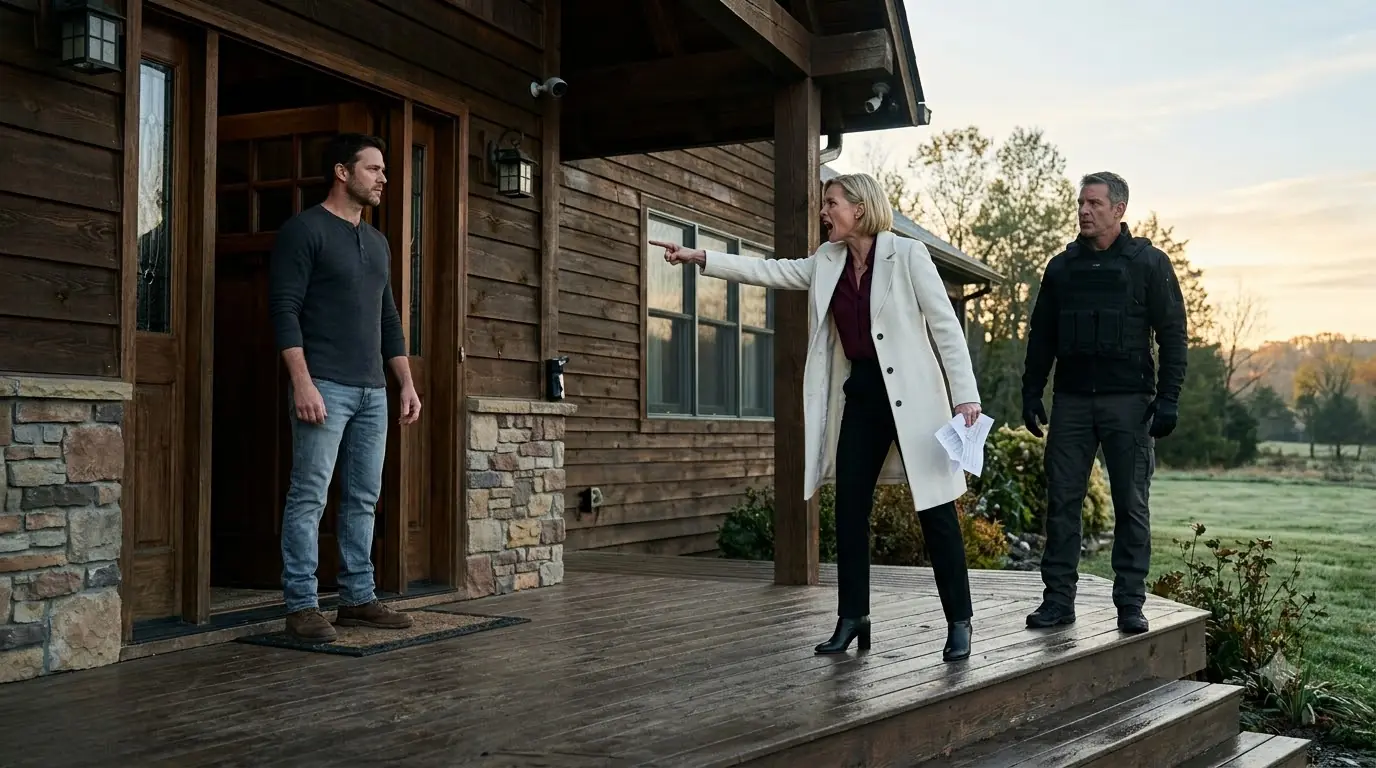
What she did not know was that the man behind that door had spent twelve years as a Force Recon Marine surviving missions far more dangerous than her hired crew could imagine.
By the time the door shattered, every camera was recording, and every man who stepped inside had walked into the worst mistake of his life.
Before any of it began, before the trucks, the battering ram, and the woman in the white coat screaming orders across his own front yard, there had been only a quiet man and a quiet house. Almost no one in Stonehaven Ridge understood what kind of quiet that truly was.
Grant lived alone in a timber-framed house set on eighteen acres at the edge of a neighborhood called Stonehaven Ridge in the rolling hills of Virginia.
The land had belonged to his uncle long before any developer drew a line on a map, and the house itself had stood there for decades, weathered but solid, before Stonehaven Ridge existed as anything more than empty pastureland. When a luxury housing development finally rose around it, the newly formed homeowners association began sending Grant letters. They were polite at first, then increasingly demanding.
The association insisted that he repaint his house to match its approved palette, remove the flagpole that honored his years of service, relocate his tool shed, and pay a mandatory joining fee of $17,600.
His property, however, had never been part of the community and never would be. Grant answered every letter the same way, calmly and without emotion, attaching copies of his deed and the county plat map proving that his land had existed independently long before the association was chartered.
Still, the woman who ran the association kept appearing at his gate with two board members trailing behind her. Marla Voss was fifty-one, sharp-featured, and immaculately dressed.
She insisted that because Stonehaven Ridge now surrounded Grant's property on three sides, he was somehow obligated to follow its rules regardless of what the paperwork said. Grant never raised his voice during those visits.
He simply asked her to leave his private property, watched her return to her car, and quietly noted the license plate, the time of day, and every word she said. He filed those details away with the same methodical discipline he had once used to record terrain features and hostile movements on deployments most people would never hear about. What Marla did not say aloud, though she thought it every time she looked at his land, was that a development company called Westmore Leisure had offered the association $11 million for access to the lake behind Grant's property.
Without a road through his land, there was no way to reach the lake. Without the lake, there was no resort, no $11 million, and no way to quietly cover the enormous hole already opened in the association's finances.
When Grant refused to sell, refused to join, and refused to be intimidated, Marla decided that his refusal was simply an obstacle to be removed. One afternoon, on her way back to her car, she turned at the end of his driveway and told him that within a month he would no longer be standing on that land.
Grant said nothing. He only watched her leave. A few days later, an envelope arrived in his mailbox marked as a final eviction and property surrender order. It warned that if he did not vacate within seventy-two hours, the association had the authority to use what it called an authorized enforcement team to remove him.
Grant studied the signature at the bottom. It belonged to a judge who, as far as he already suspected, had never seen the document in his life. He understood immediately that Marla Voss had crossed a line that had nothing left to do with homeowner regulations.
He photographed the letter and sent copies to his attorney, Tessa Whitlock, a meticulous thirty-nine-year-old property fraud specialist who had warned him months earlier that the association's paperwork looked suspiciously inconsistent.
Within a few phone calls, Tessa confirmed what Grant already suspected. No lawsuit had been filed against him anywhere in the county system. No judge had signed an eviction order bearing his name. The case number printed on the document belonged to an unrelated bankruptcy filing that had closed four years earlier.
The court seal had clearly been copied from a public record and pasted onto the page. The signature on the supposed homeowners association membership agreement, which Marla claimed Grant had signed years earlier, did not match his handwriting in a single stroke.
Tessa wanted to file an emergency injunction immediately, but the courthouse would not review new filings until Monday morning. Marla's seventy-two-hour deadline expired before dawn on Sunday, a timing far too convenient to feel accidental.
When Grant contacted the sheriff's office to report a likely threat of unlawful forced entry, the on-duty deputy logged it only as a civil dispute. The association had already filed its own complaint accusing Grant of illegally occupying community property. That false report had planted a narrative in the system before anyone in uniform ever set foot on his land. Grant understood exactly what it meant.