“Miss Freeman,” he said, his tone softer now, almost apologetic, “I must admit that I misjudged you. I assumed you were a child far beyond her depth. I was wrong.”
Harper did not respond immediately. She allowed his words to settle across the room before answering.
“Thank you, Your Honor. But this is not about me. It is about holding everyone—prosecutors, judges, and even attorneys like myself—to a higher standard. That is what justice should be.”
The judge nodded slowly.
“Well said.”
He took a deep breath before delivering his final ruling.
“Based on the lack of credible evidence and the procedural violations brought to light, I have no choice but to dismiss this case. Miss Freeman, you are free to go.”
The gallery erupted. Some people applauded. Others whispered furiously among themselves. A few left the courtroom, clearly dissatisfied with the outcome.
Harper stood in place for a moment, letting it all wash over her. Then, with a small, respectful nod to the judge, she gathered her papers and turned to leave.
As she walked down the aisle, people moved aside to let her pass. Their eyes followed every step. Some looked at her with awe. Others looked at her with newfound respect.
Harper did not linger.
She pushed open the heavy double doors and stepped into the sunlight outside. A reporter rushed toward her, microphone in hand.
“Miss Freeman, can you tell us how you managed to do this? What is your secret?”
Harper stopped and looked directly into the camera.
“There is no secret,” she said. “The law is meant to serve everyone, not only those who fit a certain mold. People like me—young, Black, underestimated—are capable of more than others assume.”
She continued, her voice steady.
“Today was not only about clearing my name. It was about proving that intelligence and determination do not come with an age limit.”
With that, she walked away, her head held high. The crowd outside watched her go. Some were still whispering in disbelief. Others were visibly inspired.
Harper Freeman was no longer simply a teenager or a lawyer. She had become a reminder that the most underestimated person in a room can be the one who changes everything.
In the end, her story was not merely about winning a case. It was about challenging assumptions, demanding.
They laughed at her in court, but this defendant was not who they thought she was. She had come prepared to rewrite the rules.
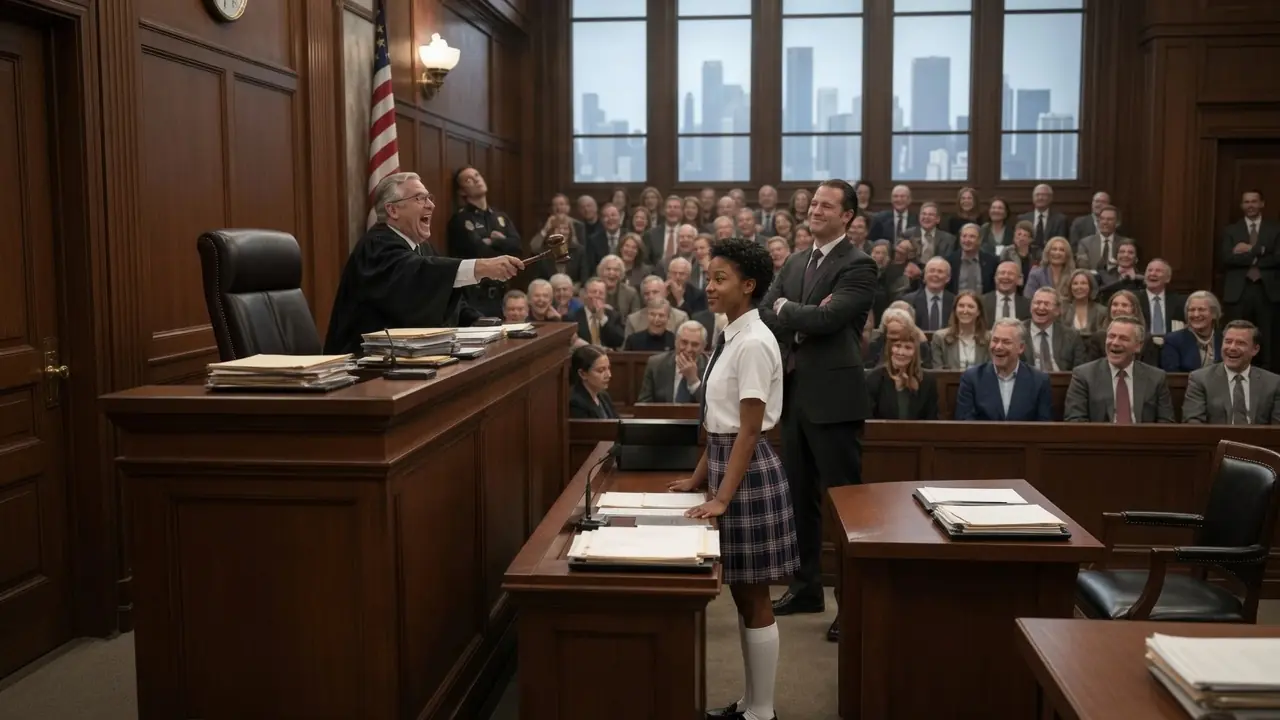
The courtroom was packed, the kind of scene one might expect in a high-profile case rather than a routine hearing. People whispered among themselves, their murmurs blending into a low buzz that filled the room. At the center of it all stood a young Black teenager, maybe seventeen at most. Her sneakers squeaked slightly as she shifted on the cold, polished floor.
She did not look nervous, at least not like someone accused of a serious crime. Her expression was calm and her hands were steady. But the judge was not impressed.
Judge Harold Brenner leaned back in his chair, his robe draped over his bulky frame as though it had been thrown on in a hurry. He peered down at the girl through his glasses, the corner of his mouth curled in visible disdain.
“Miss Freeman,” he said, drawing out her last name as if it left a bad taste in his mouth, “do you even understand what you are being accused of here?”
The room fell silent. Every eye moved between the judge and the girl.
She did not flinch or fumble with her words the way he apparently expected. Instead, she met his gaze calmly and said, “Yes, Your Honor. I do.”
Brenner scoffed and leaned forward, his tone dripping with condescension. “You are sure about that? Because this is not some after-school debate club. You are in a court of law, young lady.”
A few chuckles echoed from the gallery. For the first time, she allowed her gaze to sweep the room. Most of the people watching were older, dressed in suits, their faces hard with judgment. They looked at her as if she were a spectacle rather than a person.
She let them look. There was something in her eyes, something that suggested she knew more than they did.
But the judge was not finished.
“I do not know why anyone thought it was a good idea to let you speak on your own behalf,” he continued with a dismissive wave of his hand. “This is not child’s play. You are not equipped for this.”
Her lips parted slightly as if she might respond, but then she closed them again. A faint, knowing smile crept onto her face.
The gallery shifted, sensing something they could not yet identify. Judge Brenner took her silence as weakness and smirked.
“That is what I thought.”
What he did not realize, what no one in that room realized, was that they were not dealing with a frightened teenager who had become trapped in the system. She was not there by accident. She was there for a reason, and by the end of the hearing, everyone in the courtroom would understand why.
The judge tapped his pen against the desk in a sharp, deliberate rhythm. “Let us get this over with,” he muttered, flipping through the file in front of him. “The prosecution may proceed.”