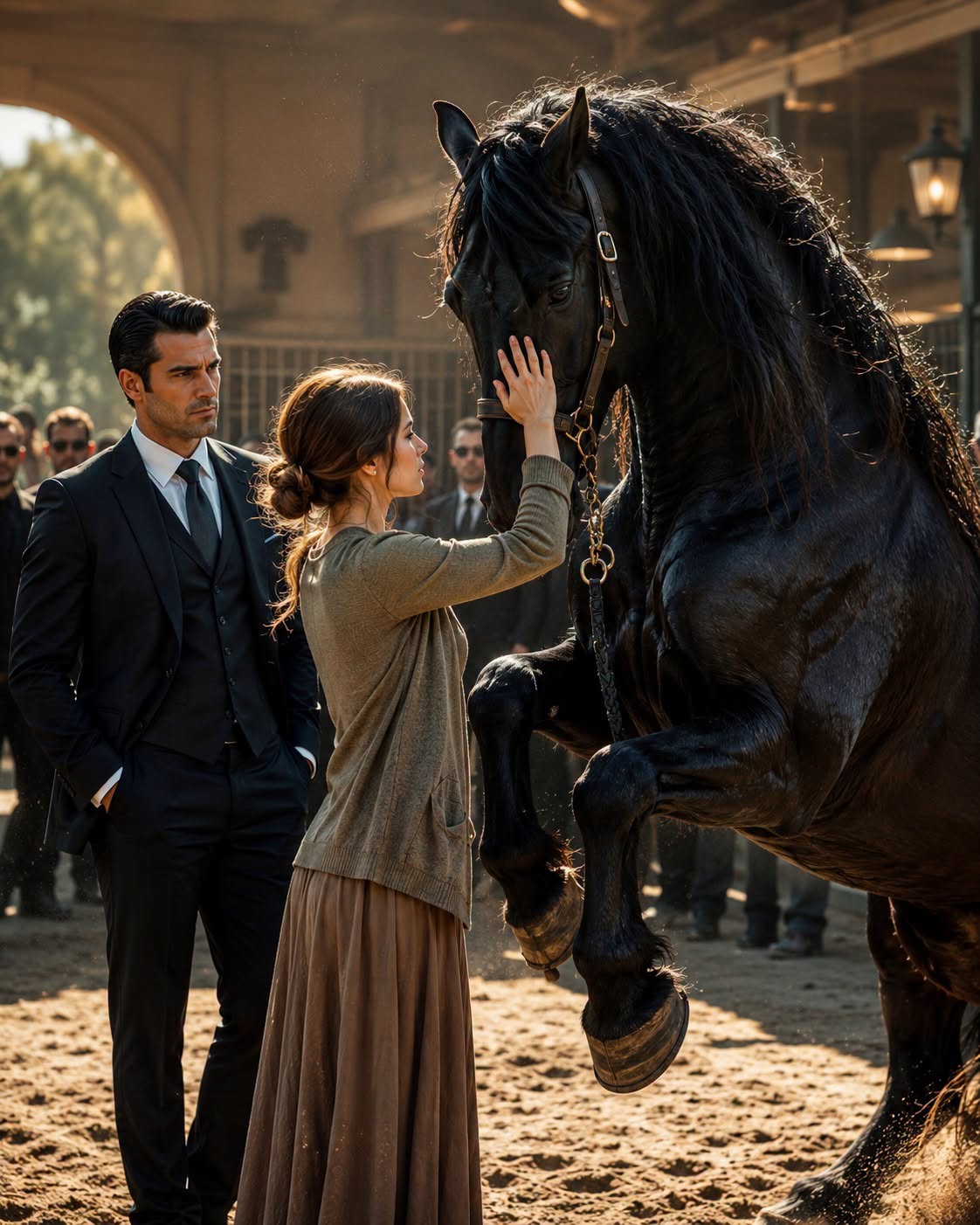
Part 2: Holly went very still on the edge of Mary’s bed.
For a moment she was no longer inside a mansion overlooking a lake in upstate New York. She was seven years old again, standing on an overturned feed bucket on a ranch outside Bozeman, Montana, her father’s calloused hand guiding her small palm to the trembling neck of a spooked mare.
Can you hear it, sweetheart? her father used to say. Horses don’t speak in words. They speak in breath, in ears, in skin. You have to listen with your whole body, not just your ears.
“Yes,” Holly said finally, her voice steadier than she felt. “The horse has a mother. She’s out there somewhere, waiting for him to find his way home.”
Mary said nothing, but her grip on the worn gray bear loosened by a fraction, some small tension in her shoulders easing that Holly recognized instantly, because she had spent years learning to read exactly that kind of quiet release in frightened creatures who couldn’t say plainly what they needed.
Later, once Mary had drifted to sleep humming along to an old Montana lullaby Holly hadn’t sung aloud in the better part of a decade, Weston stood outside the bedroom door and listened. He had not heard his daughter’s breathing settle into anything resembling peace in three long years, not since the morning a car meant to end his own life had taken his wife instead, and left a six-year-old girl carrying grief no child should have to hold alone.
That night, Holly sat in her narrow staff room overlooking the stables, scrubbing her hands for the third time though the smell of Midnight lingered regardless — straw, leather, warm animal breath, and an entire life she had sworn, eight years earlier, never to touch again.
At nineteen, the horse world across three western states had known her simply as the whisperer, a girl with an uncanny gift for reaching animals other trainers had given up on entirely. At nineteen, she had also watched a chestnut stallion rear without warning and crush her father against the concrete floor of their own barn, his ribs giving way beneath twelve hundred pounds of panicked muscle before she could cross the ten feet separating them.
The horse had said something, in the seconds before it happened. Some shift in his ears, his breathing, the particular tension along his spine that she had spent her whole childhood learning to read.
She hadn’t heard it in time.
After the funeral, she’d sold the ranch, moved her ailing mother to Seattle, and spent six more years sitting beside hospital beds while cancer slowly took the last person alive who’d known her before the horse world had turned her into something closer to legend than daughter. When her mother finally passed, Holly made two promises to herself in the quiet of that hospital room — that she would never again let anyone depend on a gift that had already cost her everything once, and that she would find work ordinary enough that no one would ever again expect miracles from her scarred, careful hands.
She had kept that promise for eight years, right up until a black stallion’s panic had called to something in her she’d buried too deep to properly silence.
The weeks that followed Midnight’s taming settled into an unexpected rhythm. Holly continued her duties with Mary each morning and afternoon, reading, walking the grounds, sitting quietly through the girl’s long silences without ever pushing her toward words she wasn’t ready to offer. But something had shifted in the household’s wider architecture as well, subtle at first, then increasingly difficult to ignore.
Weston began finding reasons to pass through the east wing during Mary’s story hour. Tristan noticed it before either of them acknowledged it aloud, watching his brother linger in doorways with the particular studied casualness of a man pretending not to listen for a voice he’d started listening for regardless.
“You’re doing that thing again,” Tristan observed one evening, finding Weston in the hallway outside Mary’s room for the third time that week.
“I’m checking on my daughter.”
“You’re checking on the nanny checking on your daughter. There’s a difference, and I think you know it.”
Weston didn’t answer, which Tristan understood, correctly, as answer enough.
It was Mary herself who first named what neither adult had yet found words for, three weeks after the incident with Midnight, sitting at the breakfast table with purple crayon in hand.
“Miss Holly,” she said, not looking up from her drawing. “Does Daddy smile more since you came?”
Holly’s cup paused halfway to her lips. “I couldn’t say, sweetheart. I don’t know what he looked like before I arrived.”
“He didn’t smile at all,” Mary said, with the plain, devastating honesty only a six-year-old could offer. “Not since Mommy. But he smiles now. Sometimes. When he thinks nobody’s looking.”
Holly said nothing, though something in her chest tightened uncomfortably at the observation, the particular ache of being seen more clearly by a grieving child than she’d expected to be seen by anyone in this careful, guarded household.
She found Weston that same afternoon in the estate’s small library, a room she rarely had reason to enter, papers and ledgers spread across an old oak desk that had clearly seen decades of difficult decisions made across its surface.
“Your daughter tells me you’ve been smiling,” she said, standing in the doorway.
Weston looked up, something wary and careful crossing his expression before he could smooth it away. “Children exaggerate.”
“Children notice things adults have stopped noticing about themselves,” Holly said. “I’ve found that to be reliably true, in every household I’ve worked.”
“And what have you noticed, Miss Bennett?”
She considered the question with the same careful weighing she gave most things that mattered. “That you watch your daughter like a man memorizing every detail of something he’s terrified of losing. That you run this entire empire with the same controlled precision, as though control is the only thing standing between you and losing everything else that matters too. And that underneath all of it, there’s a man who’s forgotten what it feels like to simply exist in a room without calculating every possible threat inside it.”
Weston set down his pen slowly. “That’s a considerable amount of noticing, for someone paid to mind a six-year-old.”
“I notice things,” Holly said simply. “It’s rather the whole of what I’m good for, when the horses aren’t demanding it of me instead.”
Something in his expression shifted, not quite a smile but adjacent to one, the particular careful warmth she’d begun noticing more often in unguarded moments. “You’re good for considerably more than that, Holly. I think you know it, even if you’ve spent years convincing yourself otherwise.”
She held his gaze a long moment, feeling something she hadn’t permitted herself to feel in eight careful years of deliberately ordinary living — the dangerous, unwelcome possibility of being seen fully, and wanted anyway, by someone whose own life carried weight she was only beginning to understand.
“I should get back to Mary,” she said finally, retreating from the moment before it could become something she wasn’t prepared to name.