The rain had been falling over Columbus, Ohio, since before sunrise, leaving a thin silver layer across the parking lot of the 7-Eleven on East Broad Street. Water rolled down the windows of a black sedan parked beside pump six, while morning commuters hurried beneath umbrellas toward the glowing convenience-store entrance.
Marcus Reed stood beside the open fuel door with one hand resting near the pump handle.
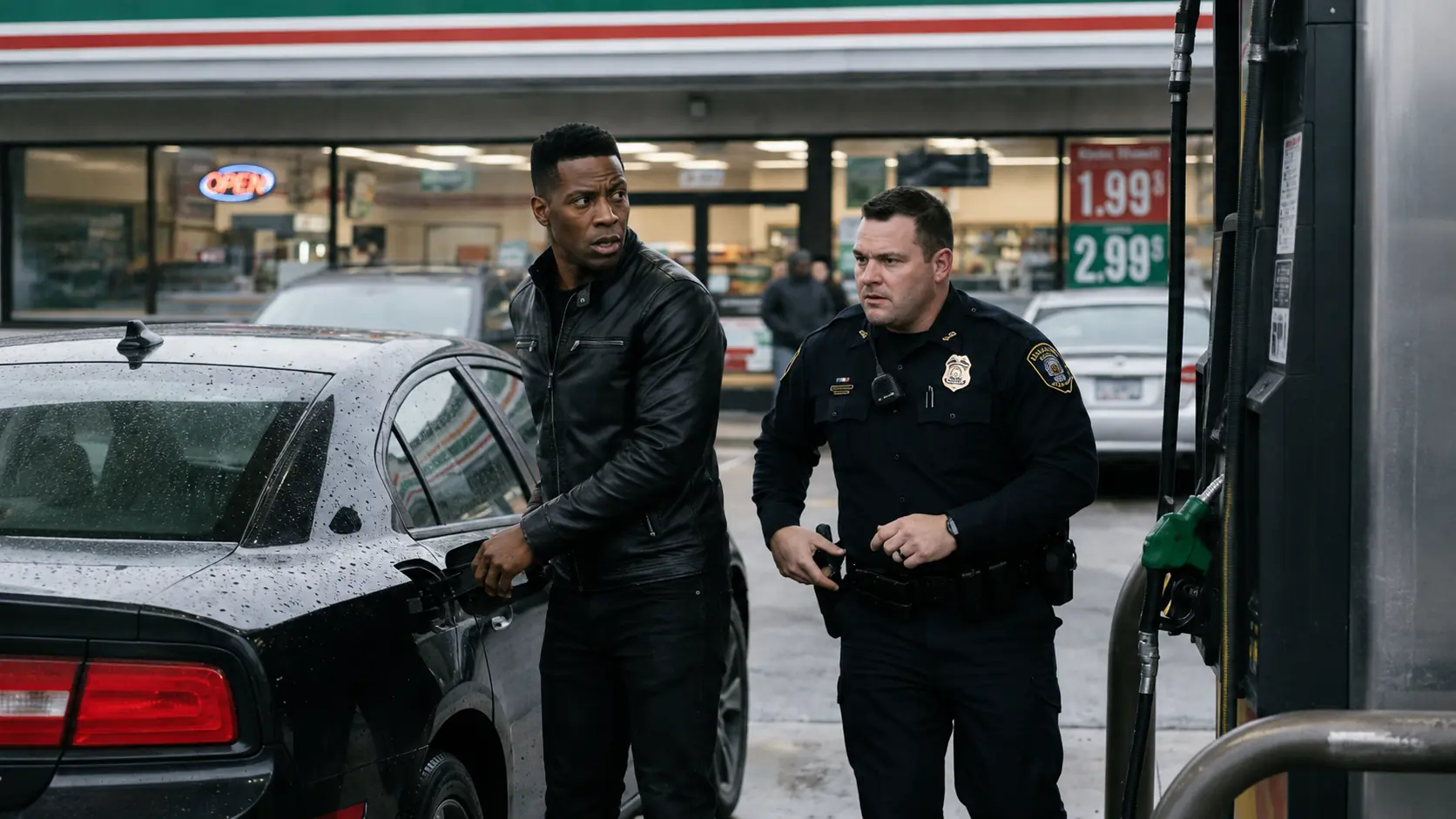
He was forty-two years old, tall and athletic, with deep-brown skin, short black hair, and a precisely trimmed beard. A fitted black leather jacket covered his dark shirt, while black jeans and weatherproof boots completed the ordinary appearance he had deliberately chosen.
Nothing about him suggested federal authority.
That was the point.
His official identification remained inside an inner pocket, secured beneath the jacket. A compact communication device was hidden inside his phone case, and a nearly invisible microphone rested beneath his collar. Three unmarked vehicles were positioned within two blocks of the gas station, but Marcus had ordered every member of his team to remain out of sight unless the situation became dangerous.
He had not stopped merely for fuel.
The 7-Eleven stood across the road from a storage facility suspected of serving as the transfer point for stolen medical equipment, illegal weapons, and cash payments to corrupt public officials. For six months, the Federal Bureau of Investigation had been tracing a network that stretched from private contractors to local law enforcement.
Someone inside the Columbus Police Department had been warning the organization before every planned raid.
Marcus intended to discover who.
He replaced the fuel nozzle and glanced toward the store window. A man in a gray hooded jacket stood near the coffee machine, pretending to read the labels on paper cups while watching the parking lot through the glass.
Marcus recognized him.
Elliot Crane.
Crane owned the storage facility across the road and had appeared in surveillance photographs with two suspected smugglers. He was not supposed to be at the gas station that morning. His unexpected arrival made the operation more valuable and more dangerous.
Marcus touched the screen of his phone.
“Target visible,” he said quietly.
Agent Lena Morales answered through his earpiece.
“We see him. Maintain position.”
A patrol car entered the parking lot.
Marcus watched it through the sedan’s rain-covered window.
The cruiser did not stop beside the store entrance. It drove slowly past pump three, turned sharply, and came to a halt behind Marcus’s vehicle, blocking him from reversing out of the space.
Officer Daniel Keller stepped out.
Keller was thirty-eight, broad through the shoulders, with fair skin, short dark hair, and the rigid expression of a man already angry before the conversation began. He wore a dark navy uniform beneath a rain jacket, and his right hand remained close to his duty belt as he approached.
Marcus turned slightly, keeping both hands visible.
“Morning, officer.”
Keller did not return the greeting.
“ID. Now.”
Marcus looked toward the pump.
“I’m buying gas.”
“I didn’t ask what you were doing.”
“Then what exactly are you investigating?”
Keller moved closer.
“You’ve been standing here watching the store.”
Marcus glanced toward the convenience store.
“So have you.”
The officer’s jaw tightened.
“Put your hands on the car.”
Marcus did not move.
“Why?”
“Because I told you.”
“That is not a legal reason.”
Keller’s hand settled over his handcuff pouch.
“Keep talking, and you’re going down.”
Inside Marcus’s earpiece, Lena’s voice became sharper.
“Marcus, say the word.”
He lifted his phone.
“Try it. The FBI is listening.”
For one brief second, uncertainty passed across Keller’s face.
Then he laughed.
“The FBI?”
Marcus remained calm.
“Yes.”
“You expect me to believe that?”
“I expect you to think before touching me.”
Keller stepped into his personal space.
“I think you’re standing outside a store that’s been hit by theft three times this month. I think you’re watching customers. And I think you’re refusing to identify yourself.”
“Was a crime reported this morning?”
“That’s police business.”
“Did anyone inside accuse me of theft?”
“I don’t need a civilian explaining probable cause.”
Marcus’s eyes moved toward the convenience-store window.
Elliot Crane was no longer near the coffee machine.
He was walking rapidly toward the rear employee corridor.
Marcus spoke quietly into the phone.
“Target moving toward the back exit.”
Keller reached for the device.
“Give me the phone.”
Marcus moved it away.
“No.”
The officer grabbed his wrist.
Marcus could have broken the hold in less than two seconds. Years of tactical training had taught him several ways to control Keller’s arm without causing serious injury.
He used none of them.
“Release me,” Marcus said.
“You’re interfering with an investigation.”
“No. You are interfering with one.”
Keller twisted his wrist and pushed him toward the sedan.
Marcus caught himself against the roof.
The rain grew heavier, striking the metal around his hands.
“Agent Reed,” Lena said urgently through the hidden earpiece. “We are moving.”
“Negative,” Marcus replied.
Keller heard him.
“Who are you talking to?”
“The people recording you.”
The officer pulled one handcuff free.
“You think pretending to be federal makes this better?”
Marcus slowly turned his head.
“I never said I was pretending.”
Keller forced his right arm behind his back.
Across the parking lot, a white delivery van remained motionless near the dumpsters. Inside it, Lena and two agents watched live video from Marcus’s hidden camera.
“Give the signal,” Lena said.
Marcus did not.
Something about Keller’s behavior had changed the moment the storage facility became visible behind him. The officer was not simply acting on prejudice or misplaced suspicion. He appeared desperate to remove Marcus before he could continue watching the building.
That made him useful.
Marcus allowed the second handcuff to close.
Keller pulled him away from the car.
“You’re under arrest.”
“For what?”
“Obstruction, refusal to identify, and impersonating a federal officer.”
Marcus looked toward the rear of the convenience store.
The emergency exit opened.
Elliot Crane stepped outside carrying a black duffel bag.
He saw Keller holding Marcus in handcuffs.
The two men exchanged a look.
It lasted less than a second, but Marcus saw it clearly.
Recognition.
Crane immediately turned toward a white pickup parked behind the store.
Marcus raised his voice.
“Keller, tell your friend to stop.”
The officer pulled him harder toward the patrol car.
“Shut your mouth.”
“You knew he was inside.”
“I don’t know what you’re talking about.”