Then they watched Crane leave the store.
The recognition between the two men lasted only a second.
It was enough.
Keller’s attorney argued that the officer acted independently and that Crane invented the cooperation agreement to reduce his own sentence. Prosecutors answered with phone records, payment transfers, and warnings sent before multiple enforcement actions.
Marcus testified for nearly three hours.
The defense attorney repeatedly asked why he had not displayed his credentials immediately.
“Because revealing my identity would have endangered the operation,” Marcus answered.
“You could have prevented your arrest.”
“I attempted to prevent it by asking Officer Keller to identify lawful grounds for detention.”
“You told him the FBI was listening.”
“Yes.”
“Was that meant as a threat?”
“No. It was the truth.”
The attorney walked closer.
“You allowed the situation to escalate because you wanted evidence against him.”
Marcus looked toward Keller.
“I did not summon him. I did not instruct him to block my car. I did not make him ignore the absence of a crime. I did not send his messages to Crane.”
He faced the jury.
“Officer Keller escalated because he believed no one would question his version afterward.”
Keller was convicted of conspiracy, obstruction, witness intimidation, misuse of law-enforcement databases, and deprivation of civil rights under color of law.
He received eighteen years in federal prison.
Crane received fourteen after cooperating.
Other defendants received sentences ranging from probation to twenty-two years, depending on their involvement.
The Columbus Police Department removed every disciplinary decision approved by Keller’s corrupt supervisor and reopened dozens of cases. Several wrongful charges were dismissed, and the city compensated individuals whose complaints had been buried.
A year after the gas-station encounter, Marcus returned to the same 7-Eleven.
The storage facility across the road had been seized and converted into a federal evidence warehouse pending sale. Pump six had been replaced, though the parking space remained the same.
Lena stood beside the black sedan holding two cups of coffee.
“You finally going to finish buying gas this time?”
Marcus accepted one cup.
“I paid for the last tank.”
“You never took the receipt.”
“I had other things happening.”
They watched commuters move through the wet parking lot.
A patrol car entered from East Broad Street.
The officer inside slowed, looked toward them, and continued without stopping.
Lena glanced at Marcus.
“Does that feel strange?”
“No.”
“Good or bad?”
“Ordinary.”
“That’s the goal, isn’t it?”
Marcus looked across the road.
Keller had entered the parking lot believing he controlled the truth because he wore a uniform. He demanded identification from someone he had no lawful reason to suspect, then used resistance to his authority as proof of guilt.
The moment became dangerous because Keller expected Marcus to be alone.
He was wrong.
But Marcus understood that thousands of people entered similar moments without hidden microphones, nearby agents, or federal authority inside their jackets.
That was the lesson he carried from the case.
Justice could not depend on whether the person beside the gas pump had an important badge.
The rain had been falling over Columbus, Ohio, since before sunrise, leaving a thin silver layer across the parking lot of the 7-Eleven on East Broad Street. Water rolled down the windows of a black sedan parked beside pump six, while morning commuters hurried beneath umbrellas toward the glowing convenience-store entrance.
Marcus Reed stood beside the open fuel door with one hand resting near the pump handle.
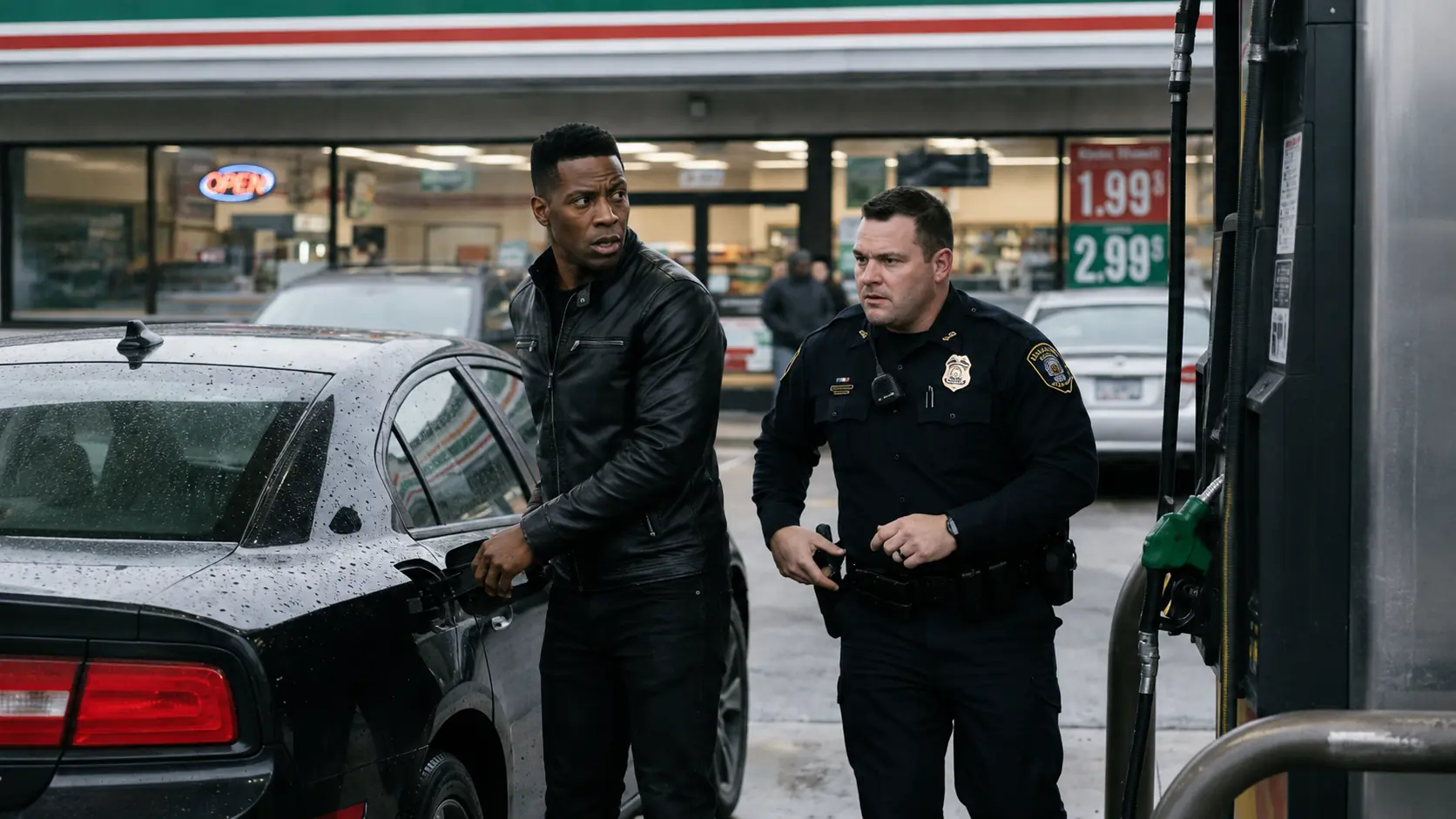
He was forty-two years old, tall and athletic, with deep-brown skin, short black hair, and a precisely trimmed beard. A fitted black leather jacket covered his dark shirt, while black jeans and weatherproof boots completed the ordinary appearance he had deliberately chosen.
Nothing about him suggested federal authority.
That was the point.
His official identification remained inside an inner pocket, secured beneath the jacket. A compact communication device was hidden inside his phone case, and a nearly invisible microphone rested beneath his collar. Three unmarked vehicles were positioned within two blocks of the gas station, but Marcus had ordered every member of his team to remain out of sight unless the situation became dangerous.
He had not stopped merely for fuel.
The 7-Eleven stood across the road from a storage facility suspected of serving as the transfer point for stolen medical equipment, illegal weapons, and cash payments to corrupt public officials. For six months, the Federal Bureau of Investigation had been tracing a network that stretched from private contractors to local law enforcement.
Someone inside the Columbus Police Department had been warning the organization before every planned raid.
Marcus intended to discover who.
He replaced the fuel nozzle and glanced toward the store window. A man in a gray hooded jacket stood near the coffee machine, pretending to read the labels on paper cups while watching the parking lot through the glass.
Marcus recognized him.
Elliot Crane.
Crane owned the storage facility across the road and had appeared in surveillance photographs with two suspected smugglers. He was not supposed to be at the gas station that morning. His unexpected arrival made the operation more valuable and more dangerous.
Marcus touched the screen of his phone.
“Target visible,” he said quietly.
Agent Lena Morales answered through his earpiece.
“We see him. Maintain position.”
A patrol car entered the parking lot.
Marcus watched it through the sedan’s rain-covered window.
The cruiser did not stop beside the store entrance. It drove slowly past pump three, turned sharply, and came to a halt behind Marcus’s vehicle, blocking him from reversing out of the space.
Officer Daniel Keller stepped out.
Keller was thirty-eight, broad through the shoulders, with fair skin, short dark hair, and the rigid expression of a man already angry before the conversation began. He wore a dark navy uniform beneath a rain jacket, and his right hand remained close to his duty belt as he approached.
Marcus turned slightly, keeping both hands visible.
“Morning, officer.”
Keller did not return the greeting.
“ID. Now.”
Marcus looked toward the pump.
“I’m buying gas.”
“I didn’t ask what you were doing.”
“Then what exactly are you investigating?”
Keller moved closer.
“You’ve been standing here watching the store.”
Marcus glanced toward the convenience store.
“So have you.”
The officer’s jaw tightened.
“Put your hands on the car.”
Marcus did not move.